
The Fragmentation of the Polish Right
 DOWNLOAD PDF
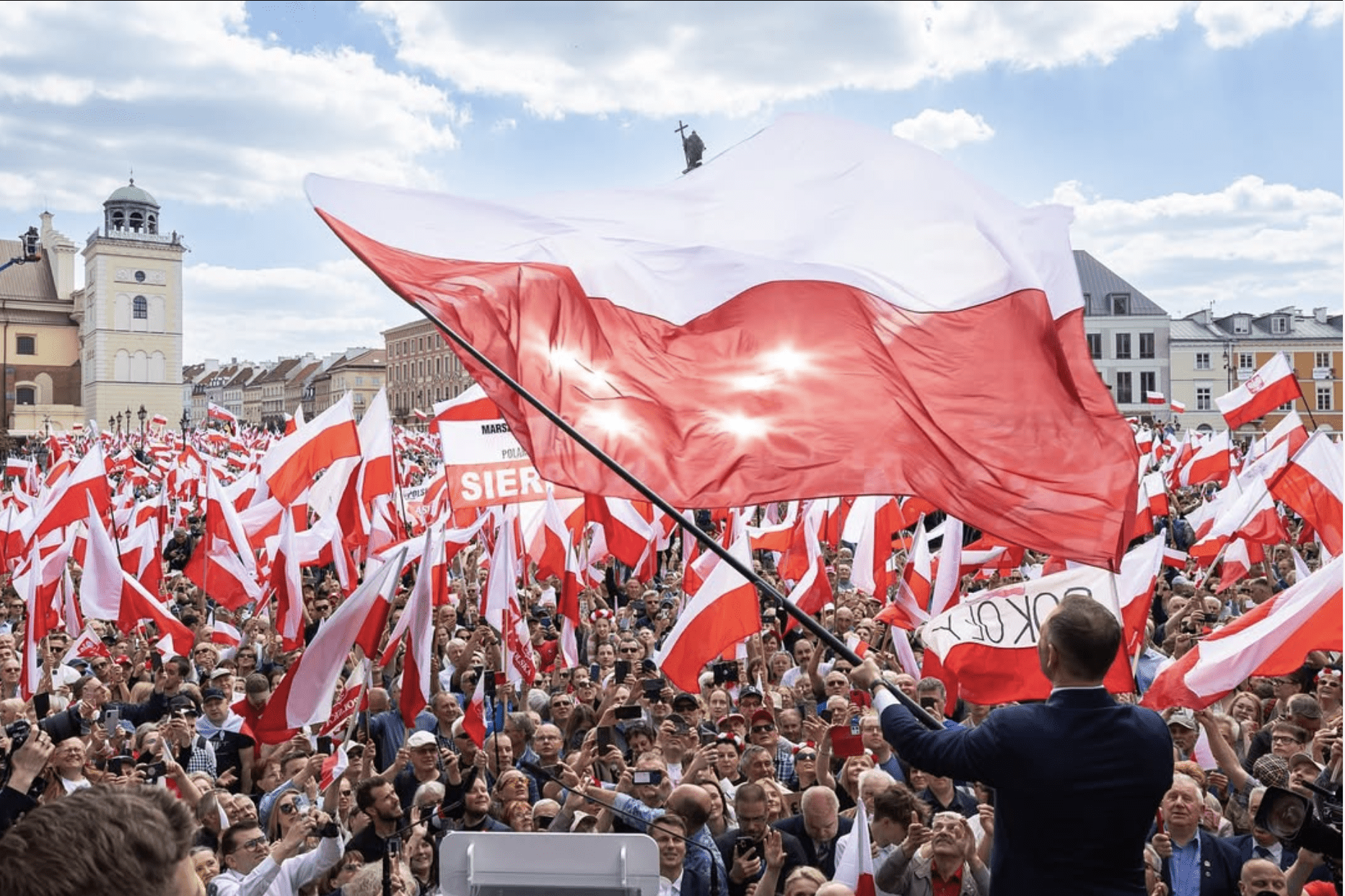
I recently visited Warsaw, in June 2026. I remember walking along the main avenue—Krakowskie Przedmieście, home to the Royal Castle and leading toward the Presidential Palace—and coming across a curious ceremony-demonstration. It would have bewildered any foreign tourist or journalist. It was an “enthronement” of Jesus Christ: a movement within the Polish Christian right calling for a monarchy in this Catholic and Slavic country, with Jesus Christ as monarch. For a long time, the political elite treated its followers as marginal, almost folkloric, and unworthy of attention. Today, however, that same scene neatly captures what is happening across the Polish right: conservative civil-society actors once dormant or neglected by traditional parties have found political channels of their own in which they feel represented.
This article argues that the fragmentation of the Polish right since 2023 should not be read as a defeat, but as evidence of a conservative civil society more diverse and more mobilized than the former PiS monopoly allowed us to see.
Many contemporary movements and parties manage to build broad majorities, or at least to accommodate different internal tendencies. Yet when their efforts in government are undermined by internal disputes or by pragmatism itself, the result is often the same: the political fragmentation of the movement. Spain’s People’s Party offers a good example. After its landslide victory in 2011, it enjoyed years of absolute majority. But its efforts to transform Spain remained limited, leaving internal factions dissatisfied by the lack of action. One could say that Ciudadanos and Vox emerged from this: two parties representing different factions of that former PP and illustrating a process of centrifugal division within the parliamentary right.
With the Spanish example in mind, it is useful to consider Poland. Jorge Buxadé stated in the European Parliament—and in an interview with Politico—that a “patriotic, conservative and anti-globalist” government was approaching in Poland. Polls from September 2026 do not entirely contradict him: PiS, Konfederacja, Braun’s Konfederacja Korony Polskiej and Morawiecki’s Rozwój Plus together receive between 45 and 55 percent of voting intentions, depending on the polling firm, compared with roughly 35–40 percent for the governing bloc of KO, Lewica and the remnants of Trzecia Droga. In other words, there is a potential right-wing majority, but it is divided among four or five parties that do not always speak to one another.
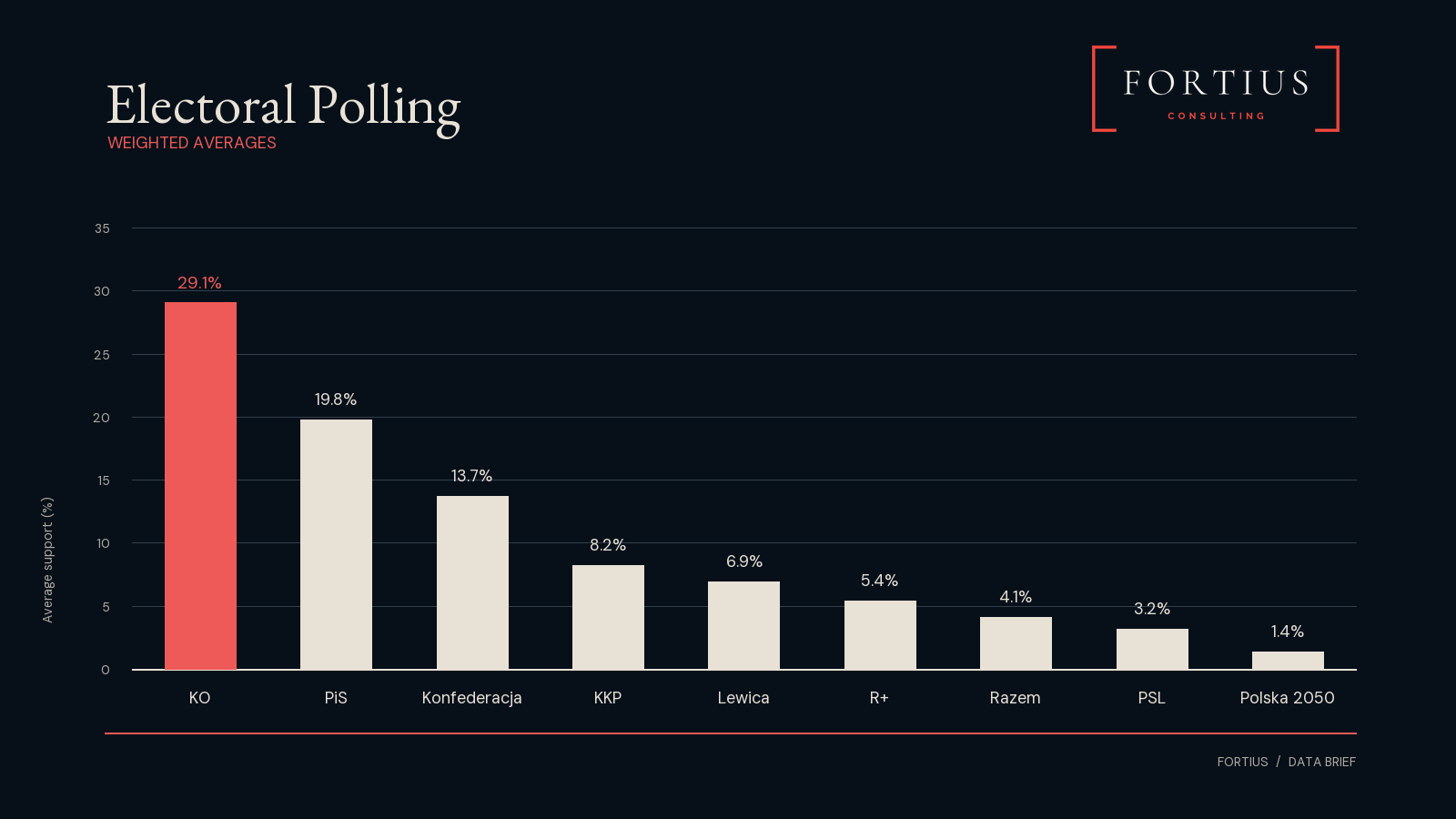
It is worth remembering, however, that fragmentation is not exclusively a problem of the right. Donald Tusk’s governing coalition—formed by his party, Koalicja Obywatelska (KO); Lewica, the main force of the parliamentary left; and the remnants of Trzecia Droga, the former centrist alliance of Polska 2050 and the PSL—has its own internal tensions and has lost support since 2023. In several recent polls, Polska 2050 and the PSL have hovered around or fallen below the electoral threshold. If this article’s argument is that fragmentation has become the new normal of Polish politics, that normal affects both blocs, not only the conservative one.
The Polish right is nevertheless more fragmented than ever, particularly since the 2025 presidential election produced a new popular consensus around a conservative president, Karol Nawrocki. At the time, all conservative parties supported the PiS candidate. Since then, however, building a broad conservative coalition has become increasingly difficult. On one side is Grzegorz Braun’s split from Konfederacja, with its more nationalist, Ukraine-sceptic and anti-immigration orientation. On the other is a new “moderate” breakaway from PiS led by former prime minister Mateusz Morawiecki, who believes that the party—now a member of the European Conservatives and Reformists group—was becoming too radical and driving away centrist voters.
Poland therefore faces a new crossroads ahead of the parliamentary elections expected in autumn 2027, with one of its most diverse parliaments since the fall of communism in 1989. The polls are clear on one point: there is democratic support for a “patriotic and conservative” government. The open question is what form that coalition will take. One possibility would be an alliance between Tusk and Morawiecki. Yet this would amount to betrayal for voters who see Tusk as Brussels’ puppet after years in government they consider wasted. At the same time, such an alliance could shift Tusk’s politics away from Lewica and Razem, the anti-capitalist formation to Lewica’s left. Another formula—one that would seriously concern Brussels and EU leaders—would be PiS + Konfederacja + Braun, with tactical support from Rozwój Plus.
This combination would be an expansion of the former coalition assembled under PiS only a few years ago. The difference is that its dissenting factions are now organized as parties in their own right, with more room to act than they had within a single majority government. Fragmentation is a genuine fact of contemporary politics, and the conservative world must adapt to it. Pragmatism is needed above all in government, but also in forming coalitions among parties that share the same political sphere.
Agreements are necessary and possible, particularly if the Polish public demands real change: a post-Tusk political renewal that does not depend on PiS exercising absolute control.
The fragmentation of the right should therefore not be read as a failure of the conservative opposition, but as the separate evolution of its different movements and social constituencies—the same conservative civil society, dormant for years, that could be glimpsed in the enthronement on Krakowskie Przedmieście. It is difficult to keep every party loyalist together after an electoral defeat such as that of 2023. Yet Poland is once again undergoing political and ideological renewal toward greater conservative diversity.
Before speculating further about coalitions, we should remember why Poland matters so much to its European and Atlantic partners. It is one of Europe’s largest economies—the sixth largest in the European Union—and has NATO’s third-largest active armed forces, with around 4.5–4.8 percent of GDP devoted to defence. Poland is firmly committed to its transatlantic alliances, anchored in the West and carrying considerable weight within the EU. A shift from Tusk’s technocratic, centrist government to a broader and more heterogeneous coalition could unsettle investors: Warsaw is among Europe’s leading destinations for foreign direct investment in technology and financial services. It could also concern European allies if the most NATO-sceptic sectors entered government. Even so, this change of phase should not be viewed with fear. Poland has a rich history and significant potential; what is required is pragmatism in reading the opportunities ahead.
Public-policy implications
For the conservative world, this fragmentation should be understood as an opportunity, not a defeat. PiS losing its hegemony over the right does not mean its policies have failed. It means that PiS must act as the principal opposition force in future coalition negotiations with parties such as Konfederacja and Rozwój Plus. Its priority must be to position itself as the natural successor to Tusk without allowing internal disputes to keep frightening voters. The opportunity to bring together all representatives of the right should not be wasted. Looking toward 2027, such a government would also provide the European right with a necessary ally for Meloni: a broad conservative coalition in Poland, as in Italy, would demonstrate to Western audiences that this phenomenon is not exclusively Italian.
That optimistic reading should not make us forget that PiS itself governed from 2015 to 2023 amid serious friction with the EU over judicial reform and the rule of law—friction that led Brussels to activate sanction mechanisms against Warsaw and that Tusk has since tried, with mixed success, to reverse. Any honest assessment of a possible return of the right to power must account for this unresolved tension, whether one agrees with it or not. But if national conservatism and the broader right continue to win elections across Europe, a pragmatic accommodation will eventually be required between the EU and these conservative-national governments.
Political alternation should in any event alarm neither investors nor NATO allies. With the exception of Braun, a new conservative government in Poland should not call into question the Polish state’s loyalty to its existing alliances or its commitments to the EU. Would it demand changes to market overregulation? Certainly. Would Poland leave NATO or the EU? Absolutely not. After Brexit, Europe’s Eurosceptic right learned that it is easier to change an institution from within than to watch it continue unchanged from outside. A broad right-wing government in Poland could establish a genuinely conservative foundation within the EU: proof that another European Union is possible without resorting to radical solutions.
In conclusion, the situation of the Polish right ahead of 2027 is “complicated” if viewed only as a proliferation of conservative electoral options. Yet that fragmentation also presents an opportunity. The era of conservative absolute majorities under a single banner will not return. Popular and pragmatic agreements capable of sustaining a governing coalition can nevertheless emerge. Achieving this will require political will from Poland’s older conservative generation, capable of opening a new stage of national renewal and revitalizing a right that has stagnated since its 2023 electoral defeat. The scene on Krakowskie Przedmieście—a monarchist faith few took seriously only a few years ago—is ultimately a metaphor for the present moment: a conservative civil society that is fragmented, yes, but also more alive, more plural and more determined to be heard than at any time since 1989. Poland therefore represents an opportunity not only for its citizens, but for European analysts and conservatives with a vocation for government.