
Foreign Interference or the Internationalization of Sovereigntism?
 DOWNLOAD PDF
With the Hungarian parliamentary elections approaching, the political atmosphere becomes ever more intense. The campaign spirit is in full ferment, political rhetoric is sharpening and accusations are flying in all directions. Among the most recurring issues of the debate is the question of foreign interference. Government supporters warn that external actors — from Brussels to Kiev — are trying to influence Hungary’s political future, while critics of Viktor Orbán argue that international conservative networks are mobilizing to support the Hungarian government.
Such cross-accusations are hardly surprising in such a polarised political environment as today's Europe. However, they also raise a deeper question about the nature of politics in the 21st century: in a world defined by global communication and transnational ideological networks, can elections in any country really remain isolated from international political currents?
Recent events illustrate the complexity of the issue. On the one hand, information has emerged that highlights how figures from the political establishment of the European Union have openly commented on the forthcoming Hungarian elections, and some have even expressed their desire for political change in Budapest. Statements of this kind — from actors integrated into the EU institutions and the Union itself — inevitably raise questions as to the extent to which European political structures might be trying to shape the internal debate in Hungary. Similar recent experiences come to mind, for example, in the recent Romanian elections.
On the other hand, in just the last few days, Hungary has hosted multiple events that reflect the growing international dimension of contemporary conservative politics. To mention just a few, last weekend the CPAC Hungary 2026 brought together conservative politicians, intellectuals, journalists and activists from all over Europe, the United States and beyond—including the Argentine president Javier Milei. I was one of the many attendees who could see the existence of an ever wider and stronger international conservative network. Just a few days later, the Patriots for Europe Summit was held in Budapest, bringing together leaders of various sovereignist parties across the EU with the aim of strengthening their cooperation on the European political scene and showing their support for Orbán in the face of the upcoming elections.
For critics of the Orbán government, meetings of this nature are often presented as evidence of a foreign influence on Hungarian political life. The presence of international allies, the circulation of political ideas through global networks or the support of foreign media platforms are interpreted as attempts to influence the Hungarian voter.
However, this interpretation is based on a questionable premise: that national politics can remain isolated from international ideological currents in an era defined by digital communication, global media and transnational political networks. Indeed, the cross-border circulation of ideas, people and parties has become an inevitable feature of contemporary political life.
For decades, the liberal and progressive field operated precisely through these types of international structures. NGOs, philanthropic foundations, academic networks, advocacy organizations and media platforms created a dense transnational ecosystem through which ideas, narratives and political strategies traveled from one country to another. From migration policy to climate governance and human rights activism, these networks shaped debates throughout Europe and throughout the Western world. Rarely were these activities described as “foreign interference.” They were generally understood as legitimate expressions of international cooperation within a shared political and cultural space.
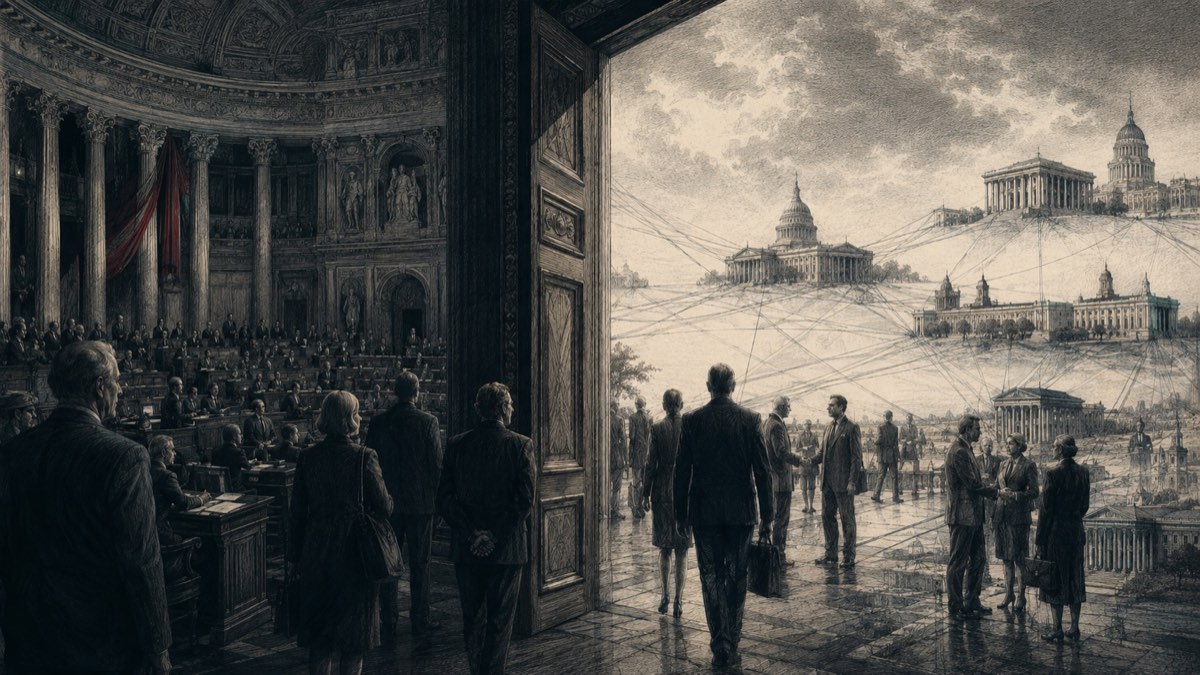
What we are witnessing today could simply be the conservative version of the same phenomenon. Over the last decade, conservative and sovereignist movements have gradually built their own transnational ecosystem. Conferences such as CPAC, think tanks networks, digital media platforms and political alliances increasingly connect actors on both sides of the Atlantic. Shared concerns about migration, national sovereignty, democratic accountability and cultural identity have favoured a growing exchange of ideas between conservative movements that previously operated mainly within national frameworks.
“If international conservatism is the earthquake of 21st century politics, Budapest is undoubtedly its epicenter.”
Hungary has played a central role in this process. Under Viktor Orbán, the country has become one of the main intellectual and political poles of the emerging sovereign world. If international conservatism is the 21st century political earthquake, Budapest is undoubtedly its epicenter.
Almost a year ago, in a report published by the Danube Institute entitled _Towards a Brave New World: Are Conservatives the New Globalists?_, I explored the emerging paradox of this development. Conservatives, though firmly rooted in patriotic traditions and in the defense of national sovereignty, are increasingly connected through global networks of conferences, political debates and intellectual exchange. Through shared political priorities, deference to national sovereignty and coexistence in international forums and conferences, these actors have begun to build what could be described as a sovereignist alternative to the liberal international order.
Within this emerging ecosystem, figures like Donald Trump and Viktor Orbán have become symbolic reference points for a broader political movement that transcends the borders of any particular nation. Their prominence reflects not only their internal political role, but also their influence within a wider network of conservative actors seeking to articulate an alternative vision for the West.
This development inevitably raises an uncomfortable but important question: Are conservatives becoming a new form of globalists?
The answer is not simple. The emerging conservative international network differs fundamentally from the liberal internationalism that dominated Western politics after the Cold War. Its central principle is not the imposition of universal norms through supranational institutions, but the defense of national sovereignty and the right of each nation to follow its own political path according to its democratic history, culture and decisions.
However, the existence of a global network of sovereignist actors inevitably produces new forms of international cooperation. Conferences such as CPAC Hungary, alliances such as Patriots for Europe and the growing collaboration between think tanks and media platforms demonstrate that conservative politics is no longer confined to purely national spaces. On the contrary, it operates more and more within a shared civilizational conversation that embraces the Atlantic world.
What is emerging, therefore, could best be described as a form of national internationalism: a paradoxical but increasingly visible phenomenon in which patriotic movements cooperate internationally while insisting that each nation retains the right to follow its own political model.
This distinction matters. Hungary’s political trajectory under Viktor Orbán is rooted in the specific historical and cultural circumstances of the Hungarian nation. The same is true of conservative movements in Italy, Poland, the United States and France. Although these movements share certain political concerns and priorities, they remain embedded in different national contexts shaped by different political traditions and social realities.
At the same time, the growing international visibility of conservative actors inevitably generates criticism from those who perceive this emerging network as a challenge to the established liberal order. From this perspective, meetings such as CPAC Hungary or the Patriots for Europe Summit are not interpreted as forums for intellectual exchange or political coordination, but as mechanisms for electoral manipulation.
However, such concerns may overlook the broader structural transformation that is taking place in global politics. The same technological and informational dynamics that facilitated the expansion of liberal internationalism are now allowing the emergence of a counter-sovereignist network.
The real question, therefore, is not whether there is international influence. It clearly exists, and has existed for decades throughout the political spectrum. The most relevant question concerns the character of the international networks that are taking shape today.
“Nations—not global structures—should remain the primary actors of political life.”
If the liberal era produced a globalism built around supranational institutions, treaties, and governance, the emerging conservative ecosystem could be building something different: a more flexible constellation of shared networks, conferences, and political instincts that operates without erasing national sovereignty.
The success of this experiment will ultimately depend on whether conservatives are able to maintain the delicate balance between international cooperation and patriotic loyalty. If that balance is preserved, the emerging network can represent not a new globalism, but a new form of civilizational dialogue among sovereign nations. If it is not preserved, conservatives could discover over time that they have built a speculative image of the global system that they once criticized.
The challenge for the new sovereignist movement is not, therefore, to deny the existence of international cooperation, but to ensure that such cooperation remains firmly anchored in the principle that nations — and not global structures — must remain the primary actors of political life.